
Students of Today, Leaders of Tomorrow
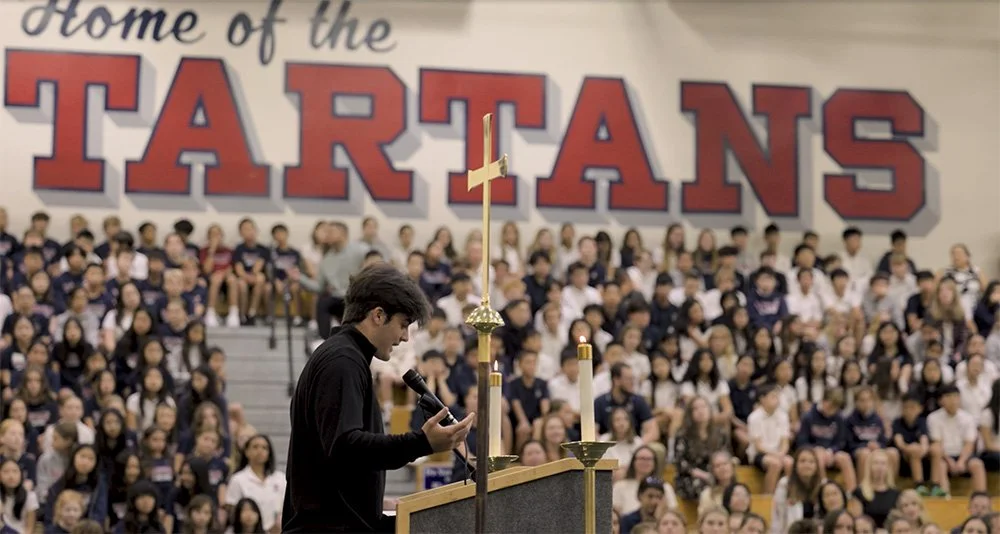
Jack Klausner, Upper School ASB president, speaks to the student body at the All-School Opening Ceremony.
Thoughtful and intentional leadership education across all divisions is driven by St. Margaret’s mission of preparing tomorrow’s leaders.
By Ryan Wood
Jack Klausner was a grade 5 student in his final year in St. Margaret’s Lower School when he decided to pursue a leadership opportunity for the first time.
As part of the Lower School’s grade 5 leadership team focused on environmental stewardship, Jack brainstormed ways he could put his own spin on the work. He decided to follow through on an idea to wear a chicken costume when visiting younger students at lunch tables to talk about the environment. “In my eyes,” he recalls, “there was no better way to get the Green Team on the map than to present it in a way that was impossible for my peers to ignore.”
It was a creative, individualized approach to leadership that Lower School teachers embraced—and it was the catalyst for a love of leadership that follows Jack to this day. Now a senior in the Upper School, Jack is the president of the Associated Student Body and is also a team captain of both the football and baseball teams.
“When in a position of leadership at St. Margaret’s, you are more closely connected to the student body than any teacher on campus,” Jack said. “You have the best opportunity to make a difference that the students around you want to see.”
Leadership development is essential to St. Margaret’s educational experience. It is prominent in the school’s mission, and is an aspect of student life that is prioritized and practiced every day.
The development of leadership skills begins in the Early School, where students learn citizenship, hold classroom jobs, and pursue self-directed projects through a play-based curriculum. It continues all the way through the Upper School, where leadership groups, student-led clubs, and opportunities in athletics and the arts offer increasingly meaningful ways to lead and contribute to the school community.
“There is an abundance of opportunities for our students to explore and practice leadership skills in a welcoming school community, and we love that our students are increasingly seeking out these opportunities,” Head of School Dr. Jeneen Graham said. “Taking on a leadership role is a big responsibility, yet such a rewarding one. Through leadership, students discover passions, build skills and ultimately leave St. Margaret’s prepared to lead and influence in a world that needs their voices.”
While formal leadership teams start in grade 5 in the Lower School, opportunities for mentorship and leadership start as young as grade 3, as the division’s Buddy program connects younger students with older students for weekly Chapel, occasional breakfasts and other classroom connections. Students as young as grade 3 can also serve as Chapel acolytes.
Once in grade 5, students apply to be part of leadership groups, overseen by Lower School Director of Community Life Tupper Spring. The process involves completing an application, attending an informational session and creating a short video based on one of the Lower School Essential Rules.
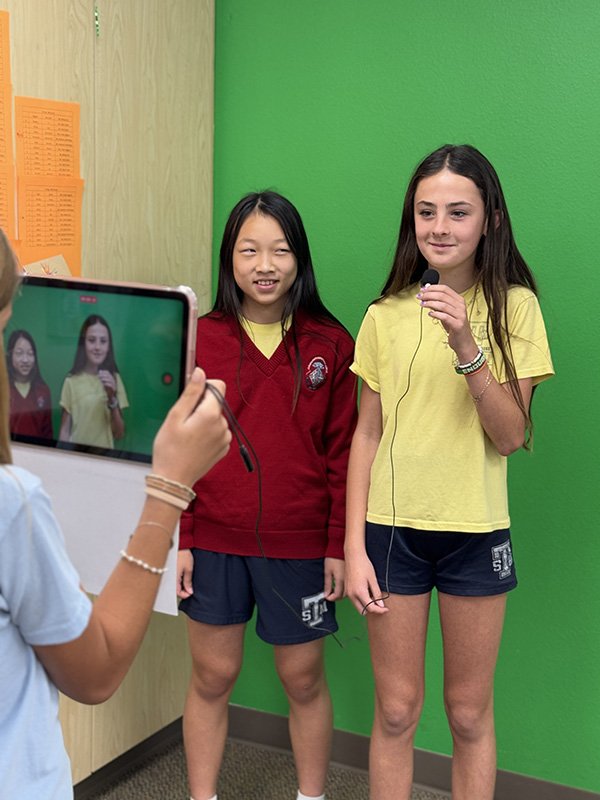
Grade 5 leadership students record a video to be played at Lower School Chapel.
Once accepted, each grade 5 leadership group meets during recess once a week, where they collaborate on projects and initiatives such as filming and editing videos for Chapel, or preparing updates on upcoming events like the PTF Book Fair, cultural celebrations like Lunar New Year, and House League activities.
Participation in grade 5 leadership has risen sharply in recent years, and survey responses indicate that 97% of participating grade 5 students are open to pursuing leadership opportunities in the future. “I like being able to help anyone who needs it and I think being in leadership has made me a better person,” one grade 5 student responded.
Jack Klausner was one of those students who thrived in grade 5 leadership and was eager to continue down the same path. As he moved into St. Margaret’s Middle School, he immediately sought out opportunities and by grade 8 was elected Middle School Student Council President.
The responsibility and freedom of the role was eye-opening.
“I had the opportunity to write my own speeches and plan my own events at just 13 years old,” Jack recalls. “It certainly did a great job of teaching me responsibility; if we could not plan and execute something as a group, teachers weren’t going to swoop in and do it for us.”
Student Council has about 10 students in grades 6-8 each year, and is responsible for organizing social events like the grade 8 dance, movie night, Spirit Week activities, and Random Acts of Kindness week. They serve as liaisons between students and faculty, and advocate for changes in student life that are frequently implemented. This year, they were instrumental in the rollout of House Leagues into Middle School student life.
“Student Council members are expected to be role model students both academically and behaviorally,” said Middle School Director of Community life Kylie Middlebrook. “Their leadership plays an important role in the culture of the Middle School, and our Student Council members do a great job of understanding and embracing that responsibility.”
Student Council is one of six different Middle School leadership groups, which also includes a new program for grades 6 and 7 called RISE. Led by Middle School Spanish teacher and DEI coordinator Meredith Vazquez, the 16 students in RISE meet weekly during lunch to plan cultural chapels and celebrations throughout the year, including Hannukah, Dia de los Muertos, Indigenous People’s Day, the Mid-Autumn Festival and more.
“The students have done an incredible job creating an environment where we celebrate our diversity,” Ms. Vazquez said. “When students see their cultures and identities reflected, it creates a deeper sense of belonging. RISE students are key voices in helping shape our overall Middle School culture.”
Other Middle School leadership groups include Admission Ambassadors, Peer Counselors and Yearbook, and an elective Service class for grades 7 and 8 which centers around serving the school community in a variety of ways. In total, 45 percent of grade 8 students participate in a leadership group, and in student surveys many express interest in pursuing leadership roles in the Upper School. One grade 8 student responded, “I hope in the future, I can do more for the community. I hope I can help to my limit.”
Once in the Upper School, the opportunities are plentiful. The Upper School has eight different designated leadership groups that meet during the school day, and 39% of the Upper School is involved in at least one. In these roles, students improve their school community, work collaboratively with peers and mentors, and hone their own skills. A few of the groups have a long history at St. Margaret’s, while others are relatively new.
“The goal of student leadership in the Upper School is to offer authentic opportunities for a wide range of students,” said Upper School Director of Community Life Lora Allison. “We want students to self-reflect, discern their personal strengths, and select a leadership group that is a strong match for them. When they go through this process they are more willing to invest in the responsibility that comes with leadership, and in turn grow personally while contributing to their school community.”
Leadership groups include:
Associated Student Body (ASB): The Upper School’s student government discusses school issues, upholds traditions, and plans activities and events that build community and spirit.
Honor Committee: Students assist the principals in upholding the Honor Statement throughout the community and assessing responsibility and consequences for policy and rules violations.
Digital Leadership: A new group that leads student discussion around AI integration, responsible use of technology and more.
Peer Counselors: Students build skills in social emotional support, kindness and empathy, as they partner with Tartans of all ages to offer mentorship and support.
Tartan Tutors: Students in grades 11-12 who offer tutoring assistance in various subjects to students across all ages.
Tartan Inclusivity and Diversity Education (TIDE): A group committed to equity and inclusion at St. Margaret’s, educating themselves on social justice topics and impacting the school community.
Yearbook: A student-led project to create a yearbook that embodies the spirit of the school and documents significant moments in the school year.
Another leadership opportunity is the Captain’s Academy. A new program for the team captains of the school’s 26 varsity sports teams, the in-season captains come together weekly to discuss their roles and how to best lead their team. The meetings have centered around specific themes like leading by example, building a team culture and conflict management, and guest speakers have included Dr. Graham, among others.
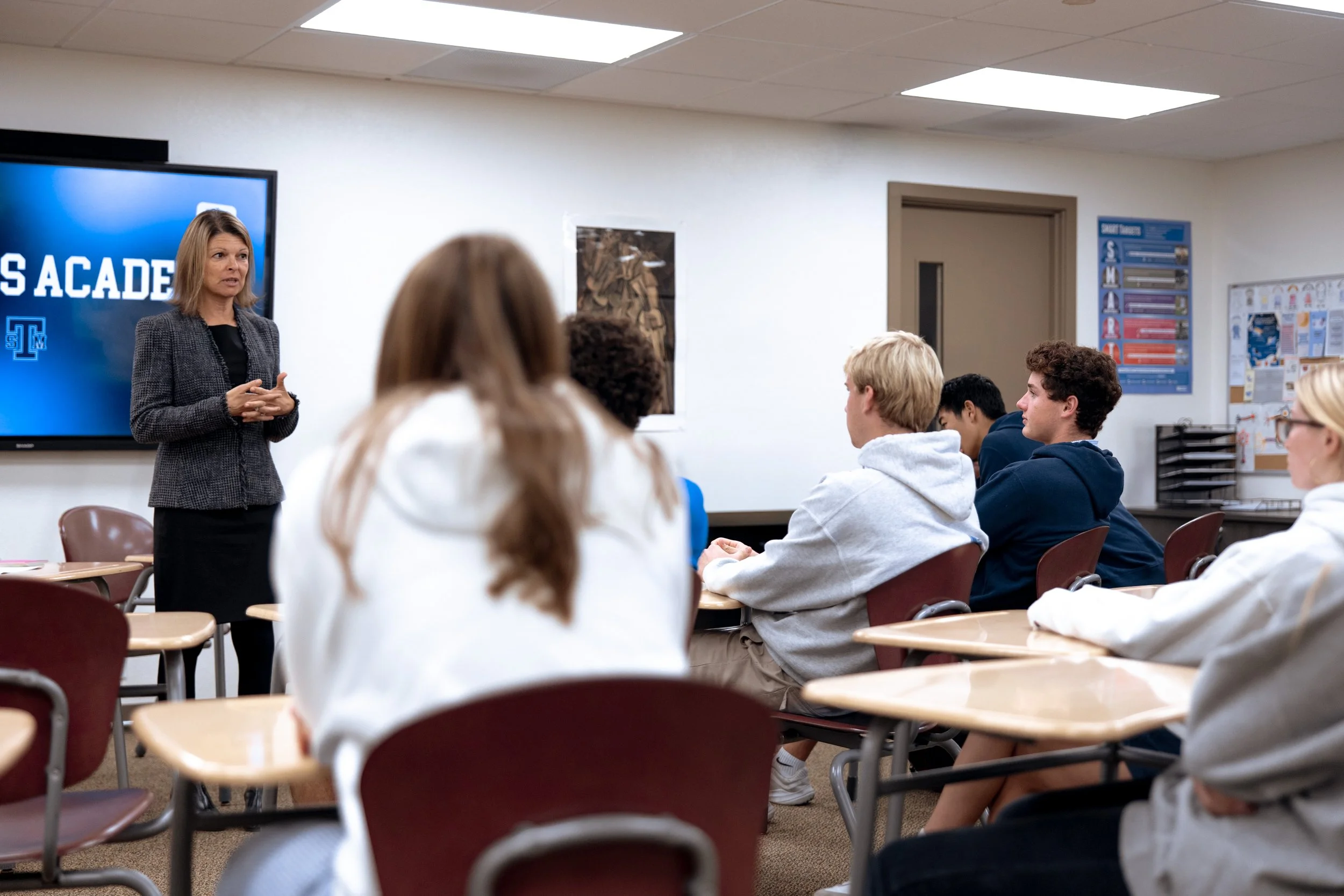
Head of School Dr. Jeneen Graham speaks to athletic team captains about leadership during a Captain’s Academy meeting.
“With more than 80 percent of our Upper School students participating in athletics,” said Dan O’Shea, St. Margaret’s athletics director and head football coach, “we understand that the captains are not just leaders on their teams, but also leaders on our campus.”
Students in the Upper School also have to chance to lead one of 12 student-led and student-driven affinity groups, which are optional meetings for individuals who identify as members of a group to build community, share experiences and co-create a sense of belonging. The Upper School has 12 affinity groups around a shared, common identity, whether it’s race, ethnicity, religion, gender, sexual orientation or ability, and the groups are open to all. While each affinity group has at least one adult facilitator, the groups are coordinated, planned and led by student leaders who work together with their peers to meet authentic needs.
Both the Upper School and Middle School also have the opportunity to lead student-run clubs. For the Upper School, more than 35 clubs and affinity groups meet monthly during Community Time and each club is completely student-led and initiated, with a faculty member serving as a sponsor. Some clubs are established and passed down over the years, while others are new and reflect the leader’s passion and vision based on a contemporary topic or discovered interest.
Clubs introduce self-motivation and responsibility among students, and are as big or as little as the officers work to make them. The authenticity of leadership in the clubs dictates that If it happens, it’s because the student leaders made it happen. Club events can include presentations in Convocation to build knowledge and awareness, bringing in guest speakers, academic competitions, and advocacy for a particular local or global issue.
Such responsibility is a hallmark of leadership—and of leadership education at St. Margaret’s. When Jack Klausner, now in his final semester at St. Margaret’s, reflects on his many years in leadership roles at the school--from the chicken costume in the Lower School, writing speeches and organizing events in the Middle School, and planning, mentoring and advocating for his peers in the Upper School—he sees the through-line of leadership education at St. Margaret’s, and how it has prepared him for a lifetime of learning, leadership and service, as directed in the school’s mission.
“St. Margaret’s teaches developing leaders to take charge of the things they want to see on campus,” Jack said. “I’ve learned the importance of always taking that charge.”